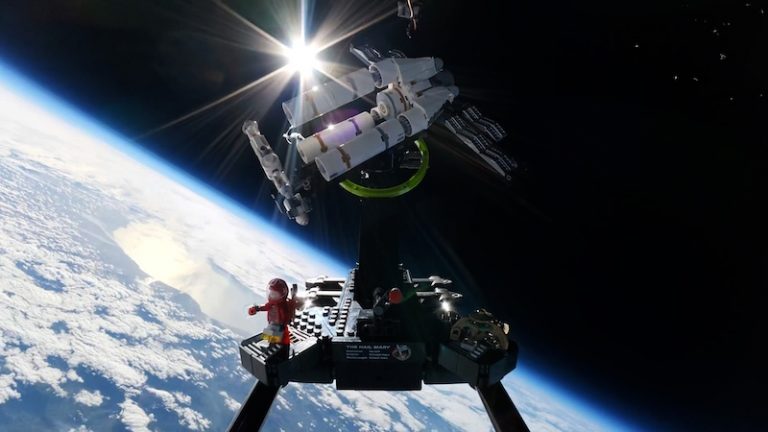
A LEGO spacecraft has reached the edge of space – and made it back – setting a new world record in the process.
A model based on the film Project Hail Mary was launched nearly 35 kilometers above Earth using a high-altitude balloon, establishing a new Guinness World Records title for the highest altitude launch and retrieval of a LEGO set.
The mission, carried out by UK-based aerospace engineering company Sent Into Space in collaboration with Sony Pictures UK, saw the LEGO model climb to 34,988 meters (114,790 feet) into the stratosphere before safely returning to Earth.
Launched from Gwynedd in North Wales on March 20, 2026, the payload included a detailed LEGO recreation of the Project Hail Mary spacecraft, complete with minifigures of protagonist Ryland Grace and the alien character Rocky.
Once airborne, the balloon carried the model to near-space conditions – where the curvature of Earth becomes visible and temperatures plunge – before releasing it for descent and recovery, completing the full launch-and-retrieval cycle required for the record.
Engineering meets imagination
The project blends cinematic promotion with real-world aerospace engineering. While visually playful, sending even a lightweight object to such altitudes requires precise flight planning, thermal protection, tracking systems, and recovery logistics.
Dr. Chris Rose, head of projects at Sent Into Space, said the mission combined technical rigor with an unusual creative brief.
“Every one of our projects is an exciting undertaking, but getting the chance to incorporate a LEGO build into the spacecraft development process made this one a whole heap of fun for the entire Sent Into Space team,” he said.
He added that the team hopes the imagery captured during the flight will help inspire future engineers and scientists.
From Guinness World Records’ perspective, the attempt also highlights the technical complexity behind what might initially appear to be a novelty stunt.
“As entertaining as it was to watch, there’s also no doubting the engineering expertise that a feat like this entails,” said Adam Millward, managing editor at Guinness World Records.
A cinematic launch strategy
The record attempt forms part of the promotional campaign for Project Hail Mary, a science-fiction film based on the novel by Andy Weir, author of The Martian.
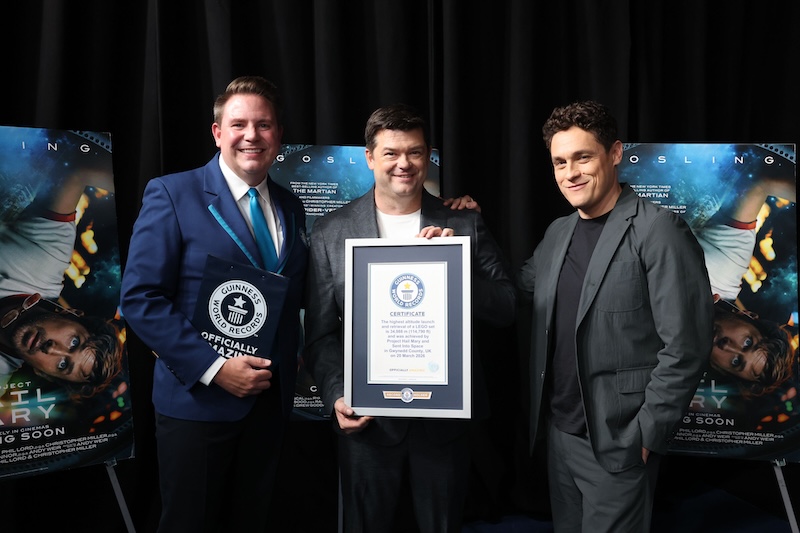
Directed by Phil Lord and Christopher Miller, the film stars Ryan Gosling as a lone astronaut tasked with saving Earth from a cosmic threat. The production team was formally presented with the Guinness World Records certificate at an event in Las Vegas earlier in April.
While marketing stunts tied to space themes are not uncommon, physically launching hardware into the stratosphere – and recovering it intact – adds a layer of authenticity that aligns closely with the film’s scientific premise.
Small payload, big altitude
At roughly the size of a standard LEGO display set, the spacecraft model may be small, but the mission profile mirrors real near-space experiments.
High-altitude balloon launches like this are increasingly used by universities, startups, and aerospace companies to test sensors, communications systems, and materials in near-space conditions without the cost of orbital launches.
In this case, the payload was designed primarily for visual impact, but the underlying flight systems reflect the same engineering principles used in scientific research missions.
Nearly 35 kilometers above Earth, the LEGO spacecraft briefly occupied a space where the atmosphere is thin, temperatures are extreme, and the sky turns black – conditions that, until recently, were accessible only through far more expensive means.