The University of Manchester has been awarded a third Milestone Award by the Institute of Electrical and Electronics Engineers (IEEE).
The award honours significant technical achievement for the invention of “Manchester Code” in 1948-1949, still used today in communications to Voyager 1 and 2 probes and everyday items like RFID card readers and TV remotes.
In a ceremony celebrating the invention’s impact on data storage, computing and communications, vice-chancellor, Duncan Iverson, accepted the award on behalf of the University, the commemorative bronze plaque will be mounted on the outside of the Coupland 1 Building, Bridgeford Street.
The Milestone award recognises exceptional technological innovation and excellence in electrical and electronic engineering; awarded to innovations which have benefited humanity via products, services, seminal papers or patents.
A bronze plaque commemorating the achievement is then placed at an appropriate site with an accompanying dedication ceremony.
Manchester remains one of the few institutions with three awards. In 2022 Manchester was awarded two IEEE Milestone awards; the first was awarded for the famed Manchester “Baby” (1948-1951) the world’s first stored computer; the second for Atlas Computer & Virtual Memory (1957-1962), introducing the concept of virtual memory, a cornerstone of modern computing.
Professor Peter Green, deputy dean of science and engineering, said: “We are honoured to receive an IEEE Milestone Award for the invention of the Manchester Code – the third such award recognising the University’s pioneering contributions to the field of Computer Science.
“From its origins with the storage of digital data on magnetic drums in the late 1940s, the reach and impact of Manchester Code endures in modern digital communication systems.”
What is Manchester Code?
Manchester Code has been a feature of computing and communications since its invention in 1948. It was first used in the University’s Manchester Mark I computer, a prototype for the Ferranti Mark I, the first commercially available computer.
Invented for the storage of data in magnetic drums, it became a standard for use in magnetic tapes and floppy disks.
It also found wide use in early ethernet networks, Radio Frequency Identification (RFID) tags and domestic remote controllers found in millions of homes across the world.
Nearly eight decades after its invention, humanity’s most distant human‑made objects, Voyagers 1 and 2, travelling through interstellar space, still communicate through the robustness of Manchester Code.
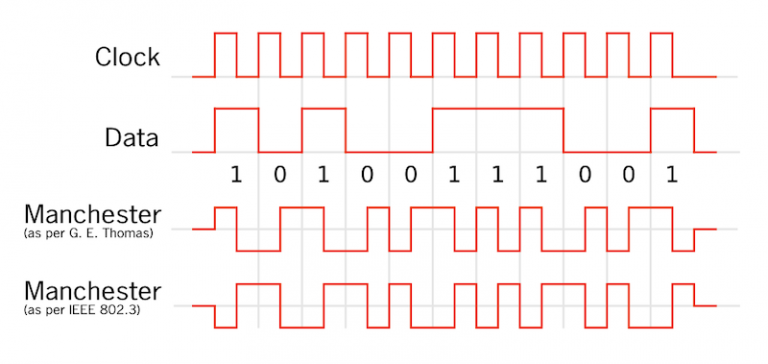
Elegantly designed, the code is “self-clocking” which means the data can be extracted from the signal without a separate clock line.
This design ensures highly reliable transmission, even across the vast distance to interstellar space, 25 billion kilometres (Voyager 1) and 21 billion kilometres (Voyager 2).
The principles of Manchester Code remain embedded in technologies we use every day; its elegant simplicity and reliability have helped accelerate the development of modern digital systems.
To this day, it remains a key fixture in modern day life, from communicating to the furthest human-made objects or simply opening a garage door.
Thomas Coughlin, past president of the IEEE, said: “The Manchester Code enabled the development of early digital storage technologies and reliable communication systems that are still in use. Humanity’s furthest space probe, Voyager 1, still communicates with earth using the Manchester Code.”