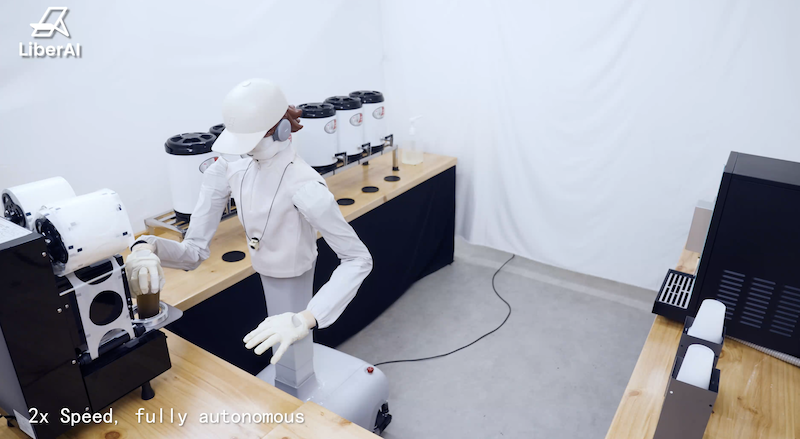
LiberAI, a physical AI startup developing foundation systems for general-purpose robots, is launching Liber-0, a World Action Model pretrained on more than 2.2 million hours of human experience to help robots learn how to interact with the physical world. (See video below.)
Liber-0 combines large-scale human video with directly recorded hand motions, visual and embodiment alignment, and embodiment-conditioned learning, with the aim of turning human experience into generalizable robot manipulation capabilities.
Founded in December 2025, LiberAI has designed its World Action Model to transfer human experience into generalizable robot manipulation capabilities.
The company has set itself an ambitious objective: to bring general-purpose home robots into everyday life by finding a more scalable way of teaching machines how to perform physical tasks.
The basic idea behind Liber-0 is surprisingly easy to understand. Humans collectively possess an enormous amount of knowledge about interacting with the physical world.
We know how to pick up a cup, open a drawer, fold a towel, turn a knob, unscrew a bottle, prepare food and perform thousands of other actions that we rarely have to consciously think about.
LiberAI wants robots to benefit from that accumulated human experience.
Traditionally, teaching robots to manipulate objects has relied heavily on demonstrations collected using robots themselves. Such data is valuable because it directly records actions the machine can execute, but collecting it requires access to robot hardware and repeated operator effort.
Human experience, by comparison, exists on an enormous scale.
Liber-0 is LiberAI’s attempt to tap into that resource. The company describes it as a World Action Model, or WAM, designed to learn relationships between visual observations, physical actions and what happens next in the world.
When LiberAI says Liber-0 has been pretrained on more than 2.2 million hours of human experience, it does not mean millions of hours were spent manually demonstrating individual tasks to robots.
Much of that experience takes the form of large-scale human activity video, providing broad exposure to people, objects, environments and physical interactions.
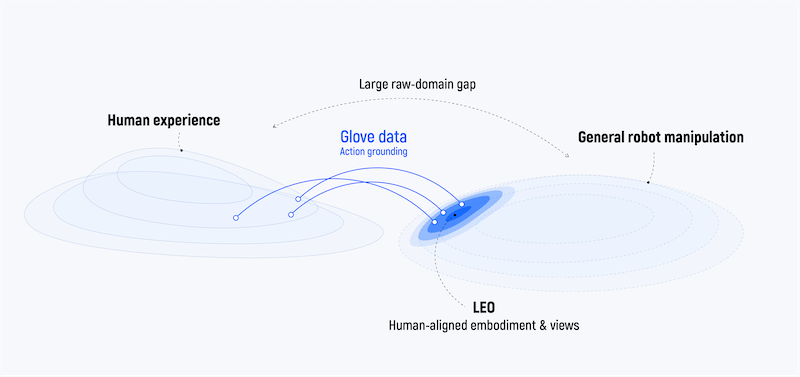
More detailed training data – including human demonstrations captured with instrumented gloves and demonstrations performed using robots – helps connect what the model sees with the physical actions that produce those results.
The objective is to turn watching into doing.
Why watching humans is only the beginning
At first glance, video might appear to provide almost everything a robot needs.
A person can watch somebody open a bottle, for example, and understand immediately what is happening. But a video doesn’t necessarily tell an AI system precisely how the person’s fingers moved, how firmly an object was held, how the wrist rotated or what sequence of physical movements produced the visible result.
LiberAI identifies three major challenges in transferring human experience to robots.
The first is visual. Human recordings and robot cameras may see the same activity from very different viewpoints.
The second is what the company calls the action-supervision gap. Hand positions and trajectories inferred from ordinary video can be incomplete or inaccurate because of occlusion, depth-estimation errors and other limitations.
The third is the “embodiment gap”. Humans and robots have different bodies. A human hand, wrist and arm may accomplish an action using movements that cannot be reproduced identically by a particular robot.
LiberAI’s approach combines several types of training material to bridge these gaps.
Large quantities of human video give Liber-0 broad visual experience of objects, environments and interactions. Robot demonstrations provide examples of actions that machines can physically execute. Between the two is one of the more interesting elements of LiberAI’s research: human demonstrations recorded using instrumented gloves.
The company’s lightweight data gloves record hand poses and trajectories as people manipulate objects. A first-person camera and two wrist-mounted cameras simultaneously record the activity.
This provides considerably richer information than ordinary video because the system can associate what is happening visually with measurements of how the person’s hands are actually moving.
LiberAI configures the cameras to resemble the viewpoints available to its robotic platform, LEO, while the gloves themselves are designed to interfere as little as possible with natural hand and finger movement.
The result is a bridge between watching human activity and understanding the physical actions behind it.
Teaching robots through human experience
The glove approach also has an important practical advantage: collecting human manipulation data doesn’t require a robot to be present.
That could make human experience a much more scalable source of physical AI training data.
Rather than requiring a robot and operator for every demonstration, people wearing LiberAI’s data-collection equipment can perform manipulation tasks while their movements and visual observations are recorded.
Liber-0 should therefore not be thought of simply as a catalog of individual programs – a “make coffee” app, a “fry an egg” app or an “open a bottle” script that is installed on a robot to give it a new skill.
LiberAI is attempting something more fundamental: building an underlying model of physical action that can learn from previous experience and generalize what it has learned across different objects and manipulation tasks.
Similarly, “learning from humans” does not mean that a robot simply stands beside a person, watches a new task once and immediately repeats it.
Human demonstrations instead become part of the accumulated experience used to train the model. The longer-term objective is for that experience to produce increasingly general physical capabilities, reducing the amount of robot-specific demonstration data required to teach new behaviors.
LiberAI has already tested this idea by combining robot demonstrations with glove-recorded human demonstrations.
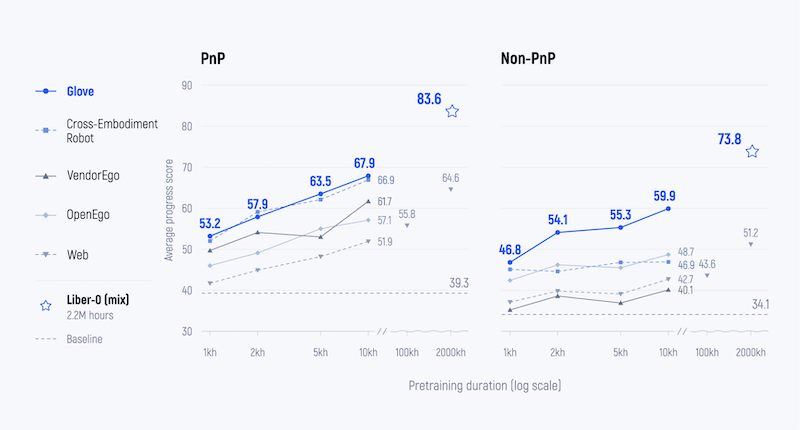
In an eight-task evaluation, a policy trained using 25 percent of the full Robot demonstration pool together with 100 percent of the Glove demonstration pool achieved a progress score of 75.6. By comparison, a policy trained using 100 percent of the Robot demonstration pool scored 72.8.
LiberAI says the full Robot and Glove demonstration pools contained equal numbers of demonstrations, indicating that glove-recorded human experience can complement a smaller amount of robot-specific training data.
The comparison does not mean the total amount of training data was reduced by 75 percent – substantial human demonstration data was added. But it does suggest that human experience can make a relatively small collection of robot demonstrations more useful.
LiberAI also investigated whether glove data could introduce manipulation behaviors that were missing from the robot demonstrations.
When robot training demonstrations covered only pick-and-place activities, the resulting policy recorded a progress score of 2.2 on other types of manipulation. Adding human glove demonstrations covering non-pick-and-place actions increased that score to 47.5, while broader glove data raised it to 54.6 – close to the 56.3 recorded by the Teleop All reference.
For LiberAI, this is an important step toward the larger objective: using human experience not merely to improve performance on known robot behaviors, but to broaden the physical capabilities a robot policy can learn.
Making robots better able to learn from people
LiberAI is tackling the human-to-robot problem from another direction as well.
If AI is expected to learn physical skills from humans, it helps if the robot can reproduce at least some of the movements humans use to perform those skills.
The company’s LEO robot therefore incorporates dexterous hands, articulated wrists and an adjustable waist, while its cameras are positioned to provide views more closely aligned with the human recordings used for training.
Consider something as simple as unscrewing the top from a bottle.
The fingers need to establish and maintain a suitable grip while the wrist rotates. Opening a drawer requires fingers to engage with the handle while the hand, wrist and arm coordinate the pulling movement. Picking something up near the floor may require the upper body to move as well as the arms and hands.
LiberAI argues that reducing unnecessary differences between human and robot movement makes human experience easier to transfer.
In tests described in the company’s technical material, LiberAI trained separate policies for its LEO robot and another robot platform, Tianji, using the same glove recordings and equal amounts of teleoperation data collected for each platform.
Across the three tasks, using matched glove data and equal amounts of platform-specific teleoperation data, LEO recorded scores of 91.3 for knob turning, 80.0 for arranging slippers and 100.0 for opening a drawer, compared with 76.3, 35.0 and 75.0 respectively for Tianji. This produced average scores of 90.4 for LEO and 62.1 for Tianji.
Alongside the hardware approach, Liber-0 uses what the company calls a Unified Embodiment Representation.
This gives the model information about the physical body performing the action. Human characteristics including height, arm length, body configuration and hand geometry are represented alongside the geometry and movement capabilities of robot arms and dexterous hands.
The important idea is that the model doesn’t have to assume every body performs a task in exactly the same way.
Instead, embodiment becomes part of the context from which the appropriate action is predicted.
A tall person, a shorter person and a robot may all open the same drawer using somewhat different movements. LiberAI wants its model to learn the underlying physical behavior while accounting for those differences.
Building a foundation model for physical action
Liber-0 can therefore be understood as part of the emerging generation of foundation models for robotics, although LiberAI specifically describes its system as a World Action Model.
There is a useful analogy with the large language models that have transformed generative AI.
Large language models learn from enormous quantities of human language rather than being individually programmed with a response to every possible question. LiberAI is pursuing a related idea in the physical world: expose a model to enormous quantities of human experience and teach it relationships between perception, action and physical outcomes.
But physical AI introduces an additional complication.
Text provides computers with a relatively common representation of human knowledge. Physical actions do not. A human hand and a robotic gripper are fundamentally different mechanisms, and even two robots may require different movements to accomplish the same task.
Liber-0 attempts to overcome this through several stages of training.
First, the model learns broad visual prediction from videos covering diverse human activities, objects and environments.
The next stage combines prediction of future visual observations with prediction of actions, bringing human video together with motion information from glove and robot recordings.
A final manipulation-focused stage places greater emphasis on precise motion and sustained physical interaction.
LiberAI says the complete Liber-0 training approach produced the strongest overall manipulation performance among the training configurations evaluated in its research.
The company is also exploring zero-shot manipulation – tasks for which the evaluated model has not been trained using robot demonstrations collected specifically for those tasks.
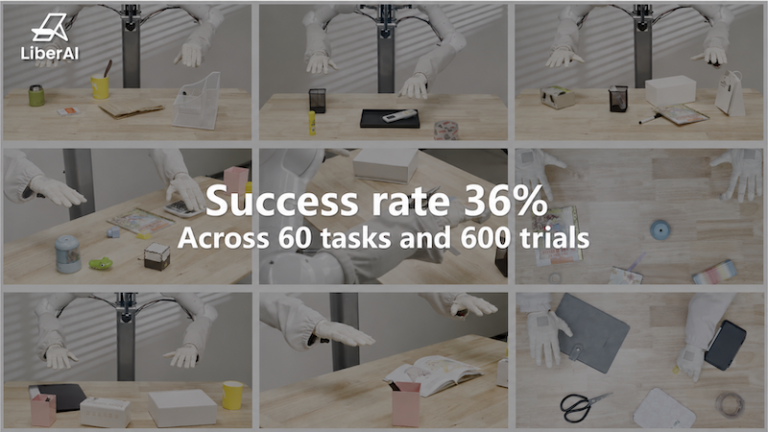
LiberAI has assembled a separate suite of 60 such tasks, divided between pick-and-place activities, other manipulation tasks and more challenging long-horizon activities. The company says Liber-0 achieved a success rate of 36 percent across the evaluation.
LiberAI has also developed an interactive simulation in which the policy received 100 hours of simulated teleoperation post-training. Following that adaptation, users can introduce their own objects and watch Liber-0 attempt to manipulate them in the virtual environment without additional object-specific training.
For longer and more complicated activities, LiberAI says Liber-0 can work with a higher-level AI agent. The agent breaks a larger objective into intermediate goals, while Liber-0 translates those goals into physical action sequences and new observations provide feedback as the task progresses.
This combination points toward something considerably broader than a library of predefined robot routines: machines able to use accumulated physical experience to work out how to achieve new objectives.
From watching humans to acting like them
LiberAI’s ultimate ambition is to bring general-purpose robots into everyday life.
Achieving that will require robots capable of dealing with an enormous variety of objects, environments and situations that would be difficult to anticipate individually.
A household robot, for example, cannot realistically depend on its developers having programmed a separate routine for every cup, drawer, bottle, piece of clothing, kitchen utensil or other object it might encounter.
That is why LiberAI believes human experience could become such an important resource.
The company also sees considerable scope to expand the richness and diversity of the experience available to its models.
Its current data gloves record hand poses and trajectories, but LiberAI says contact and force remain important dimensions for future development. Two movements that look almost identical can produce very different results depending on precisely where contact occurs and how much force is applied.
Adding tactile and force sensing could therefore provide richer supervision for activities such as inserting and fastening objects or manipulating flexible and deformable materials.
LiberAI also envisages expanding data collection into everyday environments.
Because glove-based collection does not require a robot at every location, people could potentially demonstrate useful behaviors across a much wider variety of homes, layouts, objects and daily activities than would be practical using robot demonstrations alone.
That brings Liber-0 back to the deceptively simple idea at the center of the project.
People don’t learn every physical task independently. Someone encountering an unfamiliar drawer does not normally need a lesson in how to open it. A person can pick up a cup they have never seen before, manipulate a new bottle or work out how an unfamiliar object is likely to move because they can draw on a lifetime of related physical experience.
General-purpose robots need something analogous: not merely a growing collection of programmed actions, but the ability to use previous experience when confronting something new.
LiberAI’s approach is to start with the largest source of physical experience available – humans themselves – and find ways of translating what people have learned about interacting with the world into actions robots can perform.
In other words, the goal is not simply to teach robots more individual tasks.
It is to teach them how to learn from experience.
Main image: Liber-0 achieves 36 percent overall success in a zero-shot evaluation of 60 tasks proposed by GPT-6.